Stop settling for the sponge. Most home cooks treat tofu like a wet brick of disappointment, tossing it into a lukewarm basket and praying for a miracle. We are here to conduct a rigorous Air Fryer Tofu Audit to transform that moisture-heavy block into a structural masterpiece of porous protein. This is not just cooking; it is an exercise in technical physics. We are leveraging high-velocity convection to induce rapid surface dehydration while maintaining a succulent, custardy interior. If your current results are gummy, pale, or structurally unsound, you have failed the audit. True crispness requires more than heat; it requires an understanding of surface area, starch gelatinization, and the precise removal of interstitial water. We are aiming for a golden-hued, shatter-crisp exterior that defies the natural tendencies of soy curd. Prepare to recalibrate your expectations as we strip away the moisture and replace it with crunch. This is the definitive protocol for those who demand architectural integrity in their plant-based proteins.
THE DATA MATRIX
| Metric | Specification |
|---|---|
| Prep Time | 20 Minutes (Pressing Required) |
| Execution Time | 15 Minutes |
| Yield | 2-3 Servings |
| Complexity | 3/10 |
| Estimated Cost per Serving | $1.25 USD |
THE GATHERS
Ingredient Protocol:
- 450g / 1 block Extra-Firm Tofu (Water-packed)
- 15ml / 1 tbsp Toasted Sesame Oil
- 15ml / 1 tbsp Low-Sodium Soy Sauce or Tamari
- 10g / 1 tbsp Cornstarch or Arrowroot Powder
- 2g / 0.5 tsp Garlic Powder
- 1g / 0.25 tsp Smoked Paprika
- Fine Sea Salt to taste
Section A: Ingredient Quality Audit:
The most common failure point in an Air Fryer Tofu Audit is the selection of "Firm" rather than "Extra-Firm" tofu. Standard firm tofu contains a higher water-to-protein ratio, leading to structural collapse under high heat. If you find your tofu is too fragile, it likely lacks the density required for high-velocity convection. Technical fix: Wrap the block in lint-free towels and apply a 2kg weight for 15 minutes to expel excess moisture. If your starch is clumping, it is reacting to surface moisture too early. Ensure the tofu is bone-dry to the touch before introducing the starch. If the flavor is flat, your soy sauce lacks the amino acid profile to provide deep umami; upgrade to a double-brewed shoyu to infuse the curd with more complexity.
THE MASTERCLASS
Step-by-Step Execution:
1. The Desiccation Phase
Extract the tofu from its packaging and utilize a digital scale to track weight loss during pressing. Slice the block into 2cm cubes using a sharp chef knife or a bench scraper for perfectly vertical edges. Press the cubes between heavy-duty paper towels until the surface no longer leaves a damp residue.
Pro Tip: Removing surface moisture is essential for the Maillard reaction. Water is the enemy of browning; energy spent evaporating surface water is energy not spent crisping the protein.
2. The Lipid and Umami Infusion
In a small stainless steel saucier or mixing bowl, whisk together the sesame oil, soy sauce, and spices. Toss the tofu cubes gently in this liquid gold until every surface is coated. The oil acts as a heat conductor, while the soy sauce provides the sugars and amino acids necessary for browning.
Pro Tip: Do not let the tofu sit in the liquid for more than two minutes. Prolonged exposure will cause the porous protein to re-absorb moisture, ruining your previous desiccation efforts.
3. The Starch Encapsulation
Dust the viscous coated tofu with cornstarch. Use a fine-mesh sieve to ensure an even distribution. Toss until a thin, matte film forms on the exterior of each cube. This starch layer will gelatinize and then dehydrate, creating a glass-like shell.
Pro Tip: Starch acts as a sacrificial barrier. It absorbs any remaining surface moisture and fries into a crisp lattice that protects the delicate interior from drying out.
4. Convection Calibration
Preheat your air fryer to 200C (400F). Arrange the cubes in a single layer with at least 1cm of space between them to allow air to aerate the surfaces. Airflow is the engine of this process; overcrowding leads to steaming rather than frying.
Pro Tip: Use a high-quality infrared thermometer to verify your air fryer's internal temperature. Many units run 10 degrees cool, which can result in a rubbery texture rather than a crisp one.
5. The Agitation Interval
Cook for 12 to 15 minutes. At the halfway mark, vigorously shake the basket. This redistributes the fats and ensures that the "contact points" where the tofu touches the basket are rotated, allowing for 360-degree dehydration.
Pro Tip: Listen for the sound. As the tofu dehydrates, the sound of the cubes hitting the basket will change from a dull thud to a sharp, hollow "clink." This is the auditory cue for structural success.
Section B: Prep & Timing Fault-Lines:
Timing is the difference between a golden nugget and a carbonized cube. If your tofu is browning too fast on the outside but remains mushy, your temperature is too high, preventing deep heat penetration. Lower the heat by 10 degrees and extend the time. Conversely, if the tofu is tough and leathery, you have over-cooked the interior. The goal is a rapid sear. Use a digital scale to ensure your cubes are uniform; variance in size leads to variance in "doneness," which is a catastrophic failure in any professional kitchen audit.
THE VISUAL SPECTRUM
Section C: Thermal & Visual Troubleshooting:
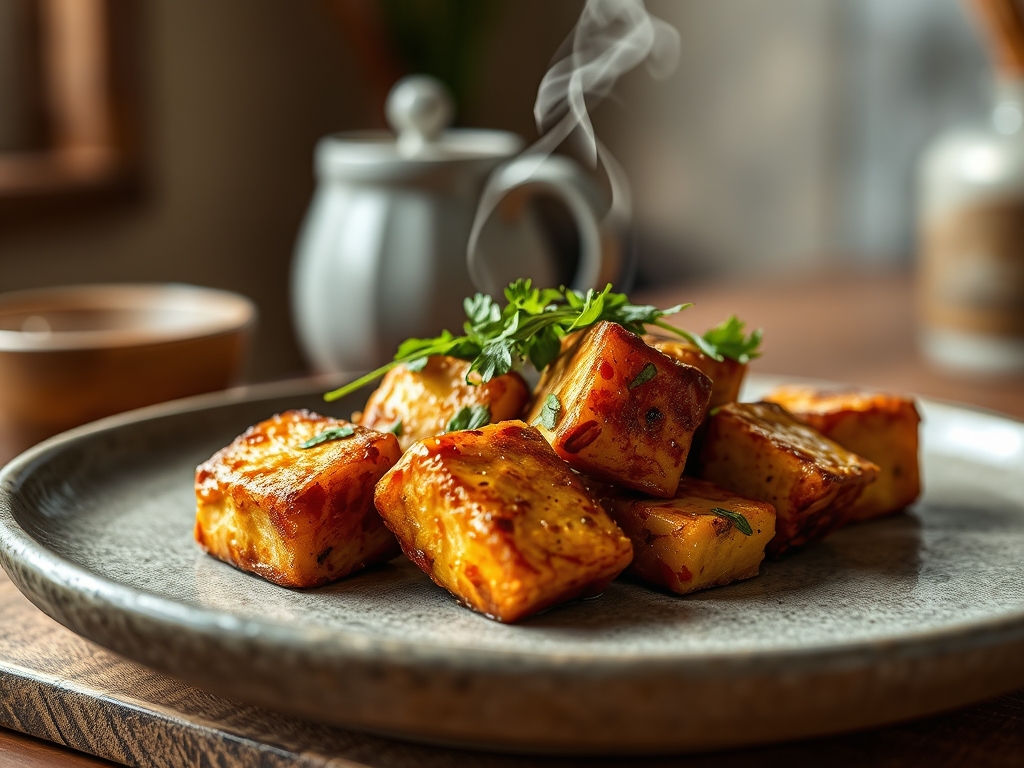
Examine the Masterclass photo above. Notice the "cratered" texture on the surface; this indicates successful starch gelatinization. If your tofu looks smooth and pale, you skipped the starch or failed to preheat. If you see dark black edges, your sugars (from the soy sauce) are burning before the protein sets; reduce the soy sauce volume or use a brand with lower sugar content. The ideal visual cue is a "shattered" appearance on the corners, where the high-velocity air has stripped the most moisture. If the color is dull, a light spray of neutral oil mid-way through the cycle can help render a more vibrant, glossy finish.
THE DEEP DIVE
- Macro Nutrition Profile: Per serving, expect approximately 180 calories, 15g protein, 10g fat, and 8g carbohydrates. Tofu is a complete protein, meaning it contains all nine essential amino acids required for human biological function.
- Dietary Swaps: For a Keto-compliant version, swap cornstarch for bovine collagen powder or crushed pork rinds. For a Gluten-Free profile, ensure your soy sauce is replaced with certified Tamari or coconut aminos. To make it piquant, add a dash of sriracha to the lipid infusion.
- Meal Prep & Reheating Science: To maintain molecular structure, never reheat tofu in a microwave. The microwave agitates water molecules, turning your crisp shell into a soggy mess. Instead, return the tofu to the air fryer at 180C for 3 minutes to re-dehydrate the surface and restore the crunch.
THE KITCHEN TABLE
Why is my tofu sticking to the basket?
This usually occurs when the basket is not preheated or the tofu is too wet. The protein bonds to the metal before the starch can set. Always preheat and ensure a light coating of oil on the basket surface.
Can I use silken tofu for this?
Absolutely not. Silken tofu lacks the cross-linked protein structure required to withstand high-velocity convection. It will disintegrate into a hot, soy-based slurry. Stick to extra-firm or "super firm" varieties for this specific audit.
Is cornstarch really necessary?
Technically no, but practically yes. Without a starch, you are relying solely on the Maillard reaction of the soy protein. Starch provides the "crunch" factor by creating a dehydrated, porous lattice that is significantly more satisfying than plain seared tofu.
How do I get the flavor to go deeper?
Tofu is a dense matrix. To truly infuse flavor, you must marinate the cubes for at least 30 minutes prior to the starching phase. However, you must thoroughly pat them dry again before the air fryer stage to ensure crispness.