Forget everything you know about the archaic ritual of the boiling cauldron. The era of watching a watched pot is dead; we are now entering the age of atmospheric precision. When you pivot to Air Fryer Hard Boiled Eggs, you are not just making a snack; you are conducting a high-velocity thermal audit on a delicate protein matrix. Imagine a high-speed fan forcing superheated air into a kinetic dance around a calcium carbonate shell. Inside, the albumin transforms from a viscous, translucent fluid into a structural masterpiece of set proteins. There is no water to buffer the heat, no bubbling turbulence to crack the shells, and no guesswork. It is a clean, dry, and terrifyingly efficient process that delivers a creamy yolk and a tender white with the surgical accuracy of a laboratory centrifuge. We are leveraging convection currents to achieve a perfect coagulated state, bypassing the mess and the thermal lag of traditional immersion. This is culinary infrastructure at its most streamlined, turning the humble egg into a masterpiece of engineering.
THE DATA MATRIX
| Metric | Specification |
|---|---|
| Prep Time | 1 Minute |
| Execution Time | 12 to 15 Minutes |
| Yield | 6 to 12 Units |
| Complexity (1-10) | 2 |
| Estimated Cost per Serving | $0.25 USD |
THE GATHERS
Ingredient Protocol:
- 6 to 12 Large Chicken Eggs (Cold from refrigeration).
- 1.5 Liters / 6.3 Cups Ice Water (For the thermal shock bath).
- Optional: 15ml / 1 Tablespoon Sea Salt (For the ice bath to lower the freezing point).
Section A: Ingredient Quality Audit:
The primary failure point in this infrastructure is the age of the raw material. Older eggs possess a higher pH level, which actually makes them easier to peel as the membrane pulls away from the shell; however, the albumin becomes less viscous and more watery. If your eggs are too fresh, the membrane will bond to the shell like industrial adhesive. To fix this, ensure your eggs are at least five days old. If you are forced to use farm-fresh eggs, increase your ice bath duration by five minutes to force a more violent contraction of the protein structure. Additionally, inspect the shells for micro-fractures. In a high-velocity air environment, any structural weakness will lead to a blowout as the internal gases expand.
THE MASTERCLASS
Step 1: Thermal Calibration
Preheat your air fryer to 132 degrees Celsius / 270 degrees Fahrenheit. While many claim preheating is optional, in a precision audit, we require a stable baseline temperature before the eggs enter the chamber. Use a digital infrared thermometer to verify the basket surface temperature.
Pro Tip: Ensuring a consistent starting temperature prevents the "thermal shock" that can cause the yolk to off-center. A professional digital scale can be used here to weigh your eggs; uniform weight ensures uniform heat penetration.
Step 2: Strategic Loading
Place the cold eggs directly into the air fryer basket in a single layer. Do not crowd the chamber. There must be sufficient space for the high-velocity air to infuse the gaps between the eggs, ensuring 360-degree thermal coverage.
Pro Tip: Use a bench scraper to gently nudge the eggs into a grid pattern. This maximizes airflow efficiency, preventing "cold spots" where the air might be baffled by overlapping shells.
Step 3: The Timed Execution
Set your timer for 12 minutes for a jammy, soft-set yolk, or 15 minutes for a fully structural, hard-set yolk. Close the drawer and do not open it. Every time you break the seal, you lose the pressurized heat required to render the proteins into their final state.
Pro Tip: Use a professional kitchen timer rather than the built-in dial on the appliance. Built-in mechanical timers are notorious for a 10 percent variance, which is the difference between a creamy center and a chalky disaster.
Step 4: The Cryogenic Shock
Immediately upon the timer's expiration, transfer the eggs into a prepared ice bath. This is the most critical phase of the infrastructure. You must halt the carry-over cooking instantly to prevent the sulfur-iron reaction that creates the dreaded green ring around the yolk.
Pro Tip: Use a stainless steel saucier or deep bowl for the ice bath. The metal helps conduct heat away from the water faster than plastic, ensuring the eggs drop below the "danger zone" of cooking in under sixty seconds.
Section B: Prep & Timing Fault-Lines:
The most common human error is the "Cold Start Fallacy." If you do not preheat, the ramp-up time of your specific air fryer model becomes a variable you cannot control. This leads to inconsistent results. If your yolks are runny but the whites are rubbery, your air fryer is likely blowing too hot too fast. Lower the temperature by 5 degrees and extend the time by 2 minutes. This slower "soak" allows the heat to migrate to the core without over-processing the exterior.
THE VISUAL SPECTRUM
Section C: Thermal & Visual Troubleshooting:
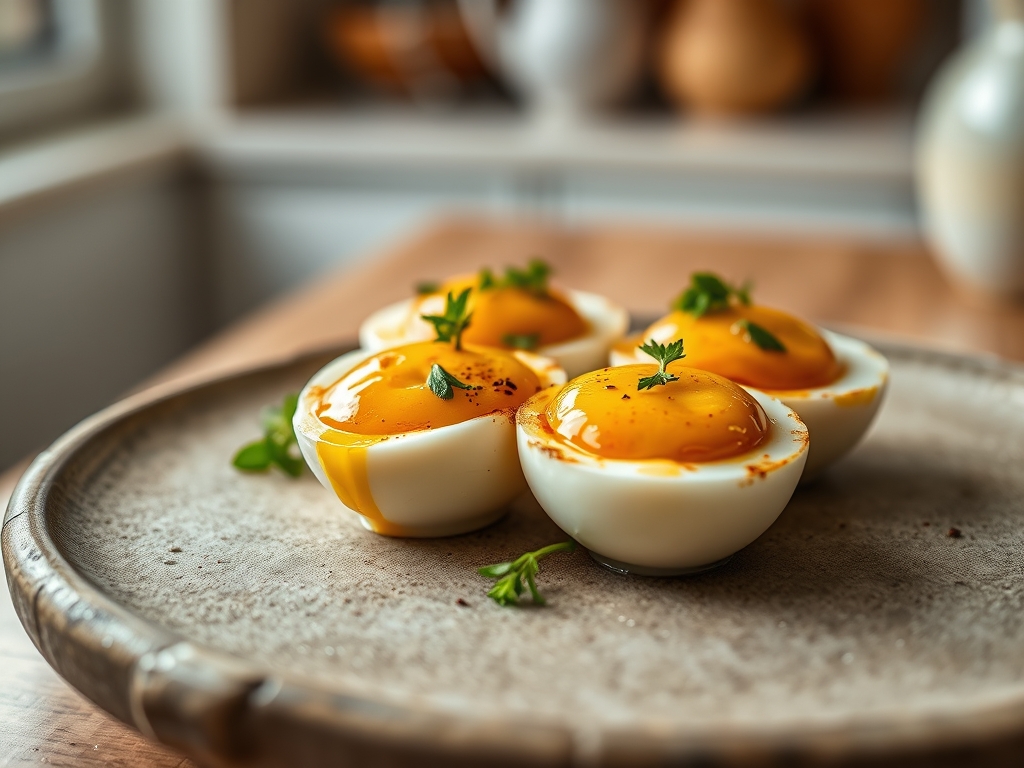
Referencing the Masterclass photo, you are looking for a pristine, matte white exterior with no brown spotting. Brown spots indicate that the eggs were not clean or that the air fryer was not degreased; residual oils in the basket can aerate and bake onto the shell. If the yolk is off-center, you likely skipped the preheating phase. If the whites have a "dimple" at the bottom, the air pocket in the egg was too large; try storing your eggs blunt-side up in the refrigerator to center the pocket. The final texture should be resilient but give way under slight pressure without shattering.
THE DEEP DIVE
Macro Nutrition Profile:
A single unit provides approximately 70 calories, 6 grams of high-biological-value protein, and 5 grams of healthy fats. It is the gold standard for bioavailable amino acids.
Dietary Swaps:
While there is no "vegan egg" that survives this specific atmospheric pressure process in a shell, those on Keto or GF diets will find this the perfect "fat bomb" or portable protein. For a piquant twist, soak the peeled eggs in a beet-juice brine to infuse them with color and acidity.
Meal Prep & Reheating Science:
To maintain the molecular structure, store eggs in their shells in a sealed container for up to seven days. Never reheat a hard-boiled egg in a microwave; the internal moisture will flash into steam, causing a pressurized explosion. To consume warm, dip the unpeeled egg in hot tap water for 3 minutes.
THE KITCHEN TABLE
Why do my eggs have brown freckles?
This is a result of the Maillard reaction occurring on the shell due to residual fats in your air fryer basket. Ensure the basket is scrubbed clean of any previous oils or food particles before beginning the egg cycle.
Why is the shell sticking to the white?
The egg is likely too fresh. Fresh albumin has a lower pH, causing it to bond tightly to the shell membrane. Use eggs that have been in the refrigerator for at least one week for the cleanest peel.
Can I cook two dozen eggs at once?
Negative. Overcrowding baffles the airflow and creates uneven thermal distribution. Stick to a single layer with at least a half-inch of clearance between each egg to ensure the convection currents can circulate effectively.
Do I need to prick the shell first?
In a convection environment, pricking the shell is unnecessary and can lead to structural failure. The steady, dry heat of the air fryer allows the internal pressure to stabilize without the violent agitation found in boiling water.